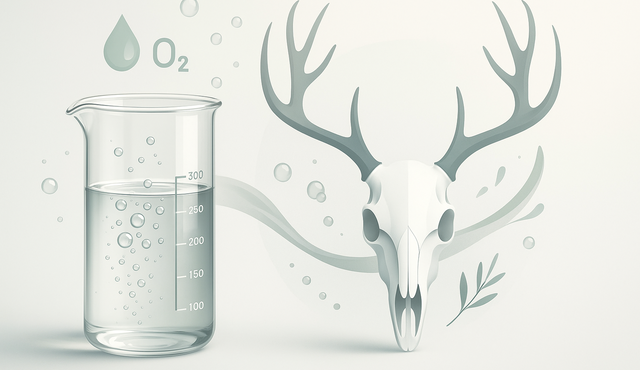
How to safely and effectively use hydrogen peroxide 35% (perhydrol) in trophy preparation? Below you will find proven procedures, concentration and temperature ranges, safety rules, and the most common mistakes along with fixes.
Why H₂O₂?
Hydrogen peroxide is an efficient, oxygen-based oxidizer. It breaks down blood products and fats, ensuring even whitening of bones, and after the process, it decomposes into water and oxygen. Unlike chlorine, it does not introduce foreign ions or cause permanent discoloration.
Scope of applications
- Skulls (“European mount”): full whitening after soft tissue removal.
- Antlers: cleaning the bony part of the skull while preserving the natural patina of the antlers (masking the antlers during bleaching).
- Teeth / weapons: gentle decolorization and hygiene, preserving details.
Safety and materials (BHP + compatibility)
- Dilution: always add H₂O₂ to water (H₂O₂ → water), never the other way around.
- Compatibility: tanks and tools made of HDPE/PP/PTFE; stainless steel 304/316 for short contact.
- Avoid: copper, brass, galvanized materials (catalysis of decomposition); long contact in a strongly alkaline environment.
- Storage: cool and in the shade; containers with venting; separation from reducers and flammable materials.
- Wastewater: before discharge, ensure the decomposition of H₂O₂ residues (time/catalysis) according to local requirements.
Standard process flow
4.1. Pre-cleaning
- Tissue removal: mechanical cleaning and rinsing.
- Maceration/degreasing: 40–60 °C, mild detergent/enzyme for 1–3 hours; avoid caustic soda and prolonged boiling.
- Rinsing: until foam and fat disappear.
4.2. Bleaching H₂O₂
Working solutions (adjust to species, age, and condition of the material):
- Skulls – full bleaching: 3–10% H₂O₂, 20–40 °C, 30–120 min.
- Teeth – gentle: 1–3% H₂O₂, 20–30 °C, 10–45 min.
- Difficult discolorations: 8–12% H₂O₂, 30–45 °C, 60–180 min (cyclically).
Control: check progress every 10–20 min; prefer 2 shorter cycles instead of one long one.
4.3. Rinsing and neutralization
Rinse in water until the reaction to H₂O₂ disappears (test strips). If necessary, apply catalytic decomposition of residues, then rinse again.
4.4. Drying and stabilization
Dry at ≤60 °C to a constant mass. Impregnation (e.g., clear bone preparation) should be done only after confirming the absence of H₂O₂.
Reference parameters – quick cheat sheet
| Element | Goal | H₂O₂ concentration | Temperature | Time | Notes |
|---|---|---|---|---|---|
| Skull of an adult individual (deer/roe deer) | full whitening | 5–10% | 20–40 °C | 45–120 min | better 2× 45–60 min than 1 long cycle |
| Skull of a young individual | gentle | 3–6% | 20–30 °C | 30–60 min | thinner bone – be more careful |
| Teeth / weapons | gentle | 1–3% | 20–30 °C | 10–45 min | check every 10 min |
| Antlers – bony part of the skull | tone alignment | 3–6% | 20–30 °C | 20–60 min | mask the antlers |
| Blood/fat stains | spot treatment | 6–10% | ambient | 5–20 min | tamponing, rinsing |
Quality control
- Visually: even whiteness, no fat stains.
- Smell: neutral, no sulfur notes.
- Structure: no chalkiness, preserved trabecularity and details.
- Residues: test strips – no H₂O₂.
- Stability: no yellowing after 2–4 weeks (storage test).
Most common mistakes and quick fixes
- Too high concentration/time → chalkiness: shorten contact; work with 2–3 shorter cycles at 3–6%.
- Lack of degreasing → stains: return to degreasing (40–50 °C + detergent/enzyme), rinse and repeat bleaching at 3–6%.
- Accidental whitening of antlers: color correction with stain/wax; next time mask and monitor liquid level.
- Yellowing over time: short bleaching 3–4% + better rinsing; expose away from direct sunlight.
Process variants
- Bath vs. tamponing/gel: for delicate areas, choose gel or tamponing to avoid oversaturation.
- Moderate heat: 30–40 °C speeds up the reaction but increases the risk of chalkiness – shorten time instead of raising concentration.
- Sequential cycle: 2–3 short cycles (e.g., 6% × 40 min) often yield a more even effect.
Simple basic protocol (for implementation)
- Preparation:
- What: Personal protective equipment (gloves, goggles/face shield, protective clothing), HDPE tub/container, H₂O₂ test strips, detergent/enzyme for degreasing, scale/cylinder for measuring.
- Why: Safe work and accurate measurement = no surprises.
- Note: Always work in good ventilation.
- Degreasing (1–3 h, 40–50 °C → rinsing)
- What: Wash in warm water with a mild detergent/enzyme, then rinse thoroughly.
- Why: Removal of fat and protein residues that cause stains and uneven whitening.
- Note: Avoid long “boiling” and strong bases – bone may “chalk.”
- Working solution (make 6% from 35% H₂O₂)
- What: Dilute perhydrol 35% to 6% (rule: add H₂O₂ to water, not the other way around).
- Why: 6% is a safe, effective starting level for skull bleaching.
- How to calculate:
- For 1 l of 6% solution, you need ~171 ml of 35% H₂O₂ + ~829 ml of water.
- For 5 l: ~857 ml of 35% H₂O₂ + ~4143 ml of water.
(Formula: C₁·V₁ = C₂·V₂ → V₁ = C₂/C₁ · V₂ = 6/35 · V₂)
- Masking antlers
- What: Protect the antlers with foil/tape or protective gel.
- Why: To preserve the natural patina; we bleach only the bony part of the skull.
- Bleaching (30–60 min, check every 15 min)
- What: Immerse the bony part in a 6% H₂O₂ solution (or another established one).
- Why: Oxidation of dyes and even lightening.
- Note: Better two shorter cycles than one long with too high a concentration.
- Rinsing (until no reaction to H₂O₂)
- What: Rinse in water until test strips show 0 residues of H₂O₂.
- Why: Residual peroxide can cause yellowing over time and problems with impregnation.
- Drying (≤ 60 °C; inspection after cooling)
- What: Dry at controlled temperature, then assess the effect.
- Why: Stabilization of color and structure; too high temperature increases brittleness.
- Repeat (optionally 3–6% for 20–40 min)
- What: If there are streaks/stains – do a second, shorter cycle with a weaker solution.
- Why: Gentle correction without the risk of “chalkiness.”
- Impregnation (optionally, after negative test)
- What: Surface protection (e.g., with a clear bone preparation).
- Condition: First absence of H₂O₂ in tests, otherwise discoloration may occur.
- Documentation
- What: Record concentrations, temperatures, times, and take photos.
- Why: Repeatability and the ability to reproduce the best result with subsequent trophies.
FAQ – frequently asked questions
Can antlers be bleached?
If you want to preserve the natural patina of the antlers – no. Mask the antlers and bleach only the skull bone.
What concentration for skulls?
Most often 3–10% H₂O₂, 20–40 °C, 30–120 min, with progress control. Better two shorter cycles than one long.
Can it be combined with chlorine?
No. Stick to one technology (H₂O₂) to avoid discoloration and introducing chlorides.
How to check for H₂O₂ residues?
After rinsing, use peroxide test strips – a negative result is a condition for drying and exposure.











 Polski
 Czech
Czech
 German
 Spanish
 Slovak