Why H₂O₂ in fruit farming?
H₂O₂ is a strong, oxygen-based oxidizer. Its decomposition into water and oxygen reduces the risk of introducing foreign ions into the system. In practical fruit farming, it is particularly valuable in areas where biofilm control, odors, and organic deposits are crucial – without leaving chlorine residues.
In short: use working concentrations tailored to the purpose, validate on small sections of the system, and always adhere to the manufacturer's recommendations and local regulations.
Main applications (fruit farming practice)
1) Hygiene of drip irrigation systems
- Removal of biofilm and slimes from lines and emitters, reducing microbiological blockages.
- Deodorization of water circulation in tanks/channels.
- Service with low doses during the season or intensive cleaning off-season (see: cheat sheet).
2) Retention tanks, wells, supply channels
- Oxidation of odors (sulfides, mercaptans) and improvement of sensory parameters of technical water.
- Assisting clarification through the decomposition of organic pollutants (pilot tests required).
3) Packing and sorting of fruits
- Surface hygiene (tables, belts, trays, boxes) after preliminary washing – solutions of 0.5–3% H₂O₂, then rinse with potable water.
- Reducing odor in organic waste and packaging washing areas.
4) Coolers and auxiliary rooms
- Hygiene of floors and hard surfaces (after washing) – solutions of 0.5–2%.
- Deodorization of drains and siphons – short rinses of 0.2–1% followed by rinsing.
Contact with food: Applications in water washing fruits or in direct contact with the product are subject to separate regulations. Use only products approved for such use and act in accordance with HACCP and the product label. In case of doubts, contact the OLE.PL advisor.
Parameters and concentration "cheat sheet"
| Area | Purpose | H₂O₂ Concentration | Temperature | Time / Method | Notes |
|---|---|---|---|---|---|
| Drip irrigation – off-season cleaning | breaking biofilm, deodorization | 1–3% | ambient | circulation 30–120 min, then rinse | leak and compatibility test; sections one by one |
| Drip irrigation – service doses* | maintaining flow | 0.02–0.1% | ambient | short applications during irrigation | *only after trials and under phytotoxicity control |
| Tanks/channels | odors, sensory parameters | 0.2–1% | ambient | aeration/mixing 15–60 min | avoid overdose – monitor oxygen |
| Packing – hard surfaces | hygiene after washing | 0.5–3% | ambient | spray/foam 5–15 min, rinse | compliance with HACCP |
| Coolers – floors/drains | deodorization | 0.2–1% | ambient | short, then rinse | do not mix with chlorines |
Health and safety, compatibility, and storage
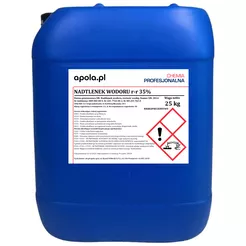
Health and safety notice: 35% H₂O₂ is corrosive and a strong oxidizer. Always work in gloves, with eye/face protection and ventilation. Dilute: H₂O₂ → water (never the other way around).
- Materials: HDPE, PP, PTFE; stainless steel 304/316 for short contact. Avoid copper, brass, and galvanized materials.
- Storage: cool, shaded, containers with venting; separation from reducers and flammable materials.
- Wastewater: before discharge, ensure the decomposition of H₂O₂ residues (time/catalytically) according to the water law permit.
- Do not mix with chlorine chemicals – risk of unwanted reactions and discoloration.
Standard operating procedure – basic protocol for orchards (to be implemented)
- Preparation: personal protective equipment, containers/tanks HDPE, volume meter, H₂O₂ test strips, ability to rinse the system with clean water.
- Preliminary washing: flush lines and tanks with water; remove mechanical contaminants and deposits.
- Working solution: prepare a solution from 35% H₂O₂ for the task (e.g., 1–3% for off-season cleaning). Principle: H₂O₂ → water.
- Cleaning drip lines: fill the section of the system with the solution, ensure gentle circulation for 30–120 min; then rinse thoroughly.
- Tanks and channels: dose 0.2–1% H₂O₂ while mixing/aerating; observe foaming and control odor.
- Packing/cooler: after preliminary washing, apply 0.5–3% H₂O₂ to surfaces, wait 5–15 min, rinse with potable water.
- Control and record: check for H₂O₂ residues (strips), complete the treatment card (concentration, time, section of the system).
- Seasonal notes: service doses during the growing season only after trials and in accordance with regulations; prefer intensive cleaning off-season.
FAQ – frequently asked questions
How to calculate dilution from 35% to 1%?
Use the formula C₁·V₁ = C₂·V₂. For 10 l of 1%: V₁ = 1/35 · 10 l ≈ 0.286 l (286 ml) of 35% H₂O₂ + 9.714 l of water.
Will H₂O₂ affect the pH of water?
At typical working concentrations, the effect on pH is minimal. Monitor pH and conductivity, especially with systems using sensitive emitters.
Can I mix H₂O₂ with fertigation?
Do not mix without verification – H₂O₂ reacts with reducers and some fertilizer components. Conduct treatments separately, with breaks and rinsing of lines.












 Polski
 Czech
Czech
 German
 Spanish
 Slovak